High calorie chemical fest challenges dietary health of at-risk Americans
A walk down the aisles of a grocery store can feel like strolling through a rainbow. Boxes and plastic packages with fluorescent colors, cartoon mascots, and catchy brand names scream for attention, promising quick, flavor-infused solutions to hunger and boredom. As much as it may be an errand, grocery shopping is an exercise in bombardment by advertising, a test of whether one can put in their cart only the things they have already placed on the grocery list, or perhaps whether those lists already reflect the internalized desire for the snacks and treats lining the shelves.
This is no accident. Widely marketed since the mid-20th century, when, amid America’s population boom, they were valued for being shelf-stable and easy to mass produce, highly processed foods now dominate store shelves and restaurant menus. In 2017, the CDC reported that roughly 80% of money spent on food marketing is used to promote fast food, sugary beverages, candy, and unhealthy snacks, much of which is targeted at children especially susceptible to advertising or parents pressed for time and desperate to find foods for picky eaters.
Activating the brain’s reward system with their sugar, fat, and sodium content, these foods can also be addictive. The CDC has estimated that 62% of calories consumed by American children and 53% consumed by adults come from ultra-processed foods, and research suggests these foods constitute approximately 73% of the U.S. food supply.
In a survey of 178 West students conducted this April, several students discussed the forces that drive them to make less healthy eating habits, often citing convenience and taste preferences.
“I feel like all the food is very unhealthy and it’s hard to find any foods that are good for me and don’t taste like crap,” one student wrote. “The foods that I do like, however, are almost always high-calorie, which is a bad thing.”
Although the term has many definitions and encompasses a wide range of foods of varying nutritional quality, “ultra-processed” generally refers to foods that contain at least one ingredient that could not be found in a kitchen and are produced by industrial means. These foods have been linked to various chronic diseases, including obesity, type 2 diabetes, certain cancers, heart disease, and mental health disorders. These foods tend to be high in sodium, saturated and trans fats, added sugars, and additives like dyes and emulsifiers, while also being low in many essential nutrients. Often absorbed quickly into the body because of their refined nutrients, ultra-processed foods also leave individuals full for less time than whole foods, making it easy to over-eat.
Ninety students raised their concerns about the health of their diets or Americans’ eating habits overall in response to an open-ended question in the April survey. The most common anxieties that students expressed were high amounts of synthetic ingredients and chemicals in foods, a general sense that most foods in the country are unhealthy, and the abundance of processed foods. Lack of access to nutritious foods and overconsumption were also frequently mentioned.
Many students discussed their fears of the health outcomes, such as autoimmune disorders and cancer, that could result from poor dietary habits, and some have even noticed the effects of processed food on their own well-being.
“Most of the food here in America is extremely processed, and I feel bloated and get more headaches when I eat the heavily processed food that is normally available for me,” wrote one anonymous student.
Since President Donald Trump appointed Robert F. Kennedy, Jr., as Secretary of the Department of Health and Human Services, food companies have come into the crosshairs of a campaign against chronic diseases. Kennedy has called for the ban of petroleum-based food dyes like Red 40, a move embraced by many states, and pushed for the FDA to develop its first formal definition of ultra-processed foods, which would aid regulation. The HHS Secretary has also called highly processed foods “poison” and went viral earlier this year body-slamming a man dressed as a Twinkie in an AI-generated video.
Amid government pressure and consumers’ tastes shifting from fears of poor nutrition, new product lines fitted to plant-based, high-protein, high-fiber, paleo, low-sugar, and other popular diets are transforming classic junk foods into seemingly healthier alternatives. However, many of these products are still produced using industrial processes that may have adverse health outcomes. In one study, participants who ate a minimally-processed food diet lost more weight, had lower blood pressure, and experienced a greater reduction in cravings than those on an ultra-processed food diet, despite the fact that both diets met U.K. nutritional guidelines.
“Americans mostly eat foods that look healthy, but in reality they aren't,” worried one student in the April survey.
Senior Carter Crowe believes that Americans should use their power as consumers to push for change in the food industry.
“This is not the government’s job, this is the American people’s job,” he wrote in the survey. “Boycott the food brands that fill their food with chemicals for the purpose of convenience and mass production. I understand that organic foods cost more, but organic foods used to be the standard 100 years ago because that was the only option.”
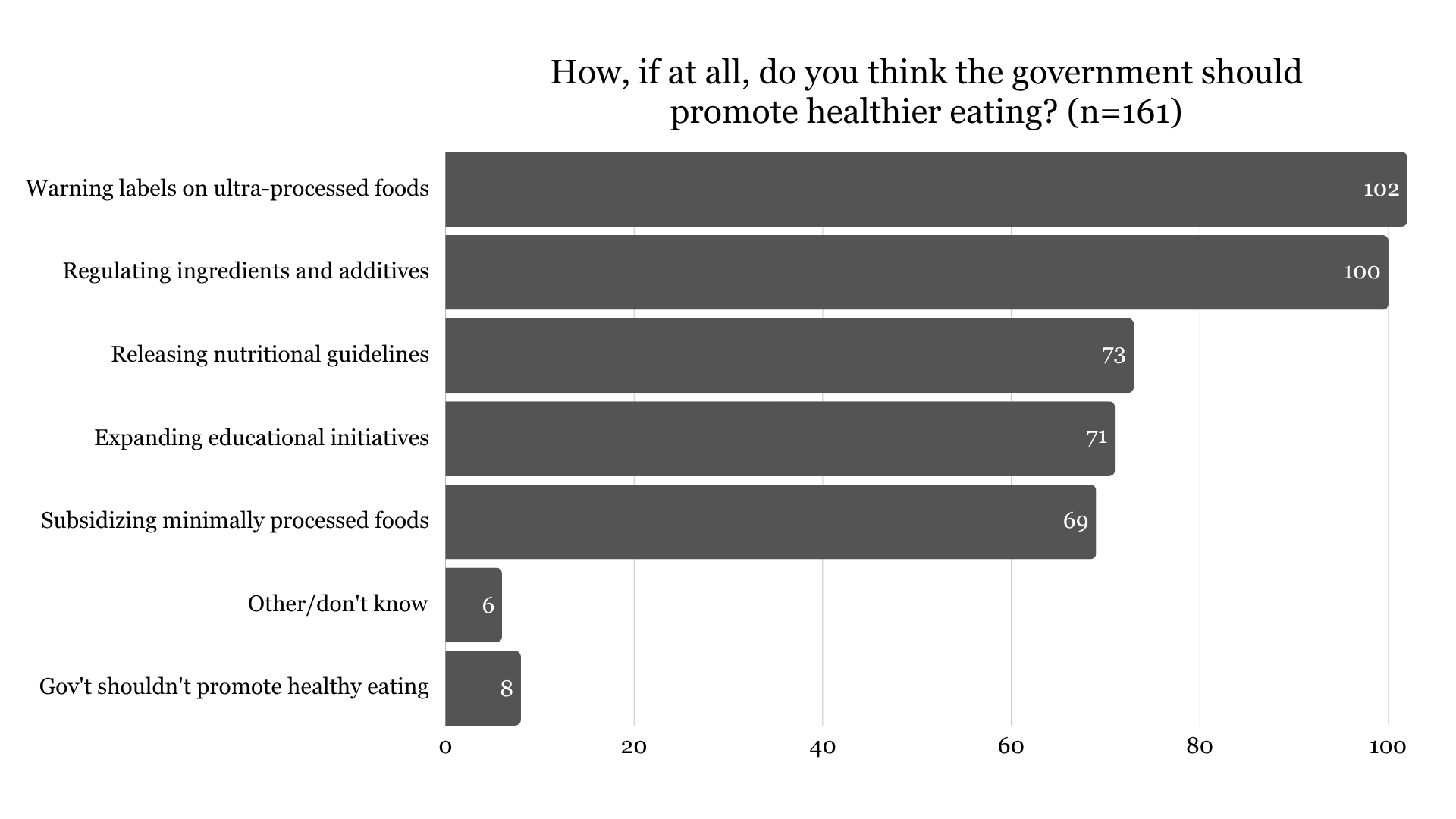
Results from the April survey suggest the majority of students hold a different view of the issue, however. Some form of government intervention to promote healthy eating was supported by 86.5% of respondents, with the most popular policy solutions being requiring warning labels on ultra-processed foods (supported by 63.4% of students) and regulating added sugar, unhealthy fats, dyes, sodium, etc., in foods (supported by 62.1% of respondents).
Junior Stella Schwersenska believes policy makers have an important role to play in making whole, nutritious foods more accessible and affordable.
“I think that without government funding or subsidization, it’s going to be a lot harder to get people on track with it, or to get big companies to comply with regulations,” she said. “If we are complicit and letting big name companies just put whatever they want in our food, then they’re going to put the cheapest options in our food, not based on our health.”
Rather than lowering the cost of whole foods, many state governments, including Wisconsin’s, have worked to raise the cost of certain highly processed foods and beverages, at least for some consumers. In March, Governor Tony Evers passed a law that will prohibit the use of FoodShare, Wisconsin’s nutrition assistance program, for the purchase of soda and candy. Meanwhile, 22 other states have sought waivers from the USDA to exempt certain desserts, sweetened beverages, and energy drinks from food stamp programs.
Promoting healthy eating involves not only setting restrictions on certain ingredients or additives, but also encouraging the inclusion of certain nutrients and food groups as part of a balanced diet. Federal dietary guidelines released earlier this year stressed the importance of eating protein, dairy, and healthy fats while placing carbohydrates at the bottom of an inverted food pyramid, receiving fanfare and criticism alike.
Miranda Prisland, a registered dietician and the Resident District Manager of Food Services in the Oshkosh Area School District, suggests that healthy eating is often simpler than changing federal guidelines and anxious discourse can make it seem.
“My standpoint has always been, all foods fit as long as you’re eating a balanced diet with a variety of fruits and vegetables filling at least half your plate, making your grains whole grains, as long as you’re getting adequate protein,” she said. “I think if we focus on the fruits and vegetables, and focus less about, what type of meat should I be eating? How much fat should I be getting? I think that can be really confusing to the public.”
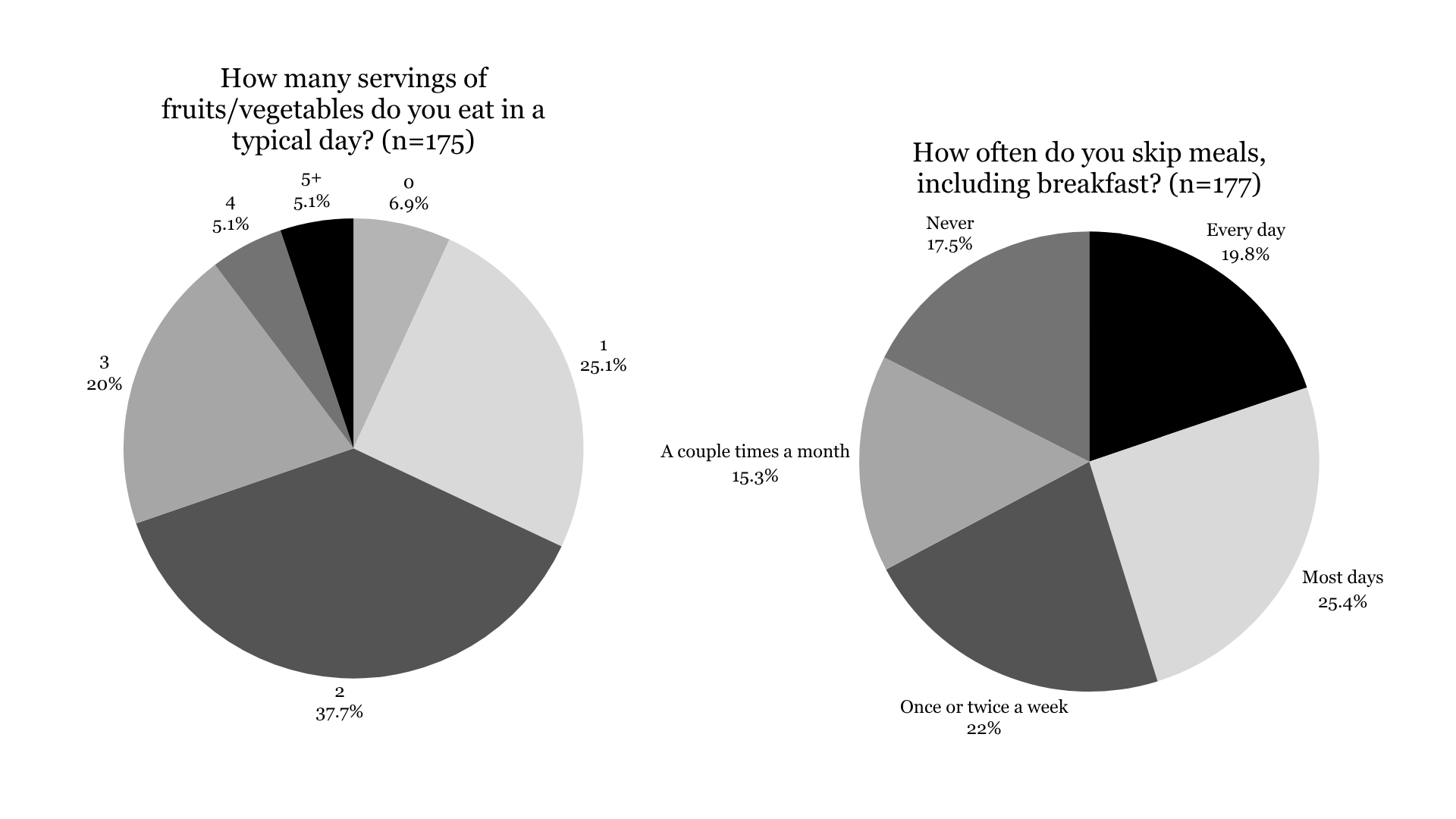
Although the new food pyramid may deviate from past guidelines, at least one part is constant: an emphasis on fruits and vegetables, which Americans are advised to have at least five servings of each day, ideally in whole form. Data from the April survey suggest that students at West have room for improvement in this area. On average, students reported eating only two servings of fruits and vegetables each day, and only nine students reported eating at least five servings of fruits and vegetables daily.
In the survey, students identified various barriers to their produce consumption, including fruits and vegetables’ high price and inconvenience relative to many processed foods.
“Lack of fresh fruit causes a lack of desire to eat healthy,” wrote one anonymous student. “I wish more fast food places had fruit as a side instead of just fried options.”
With at least one serving of a fruit or vegetable required in their reimbursable meals, schools offer a regular source of produce for students. Several students in the April survey observed that this policy can simply create food waste when students choose not to eat the obligatory fruit or vegetable, but Prisland hopes to bring more enjoyable produce options to the district’s cafeterias.
“We allocated most of our dollars, at least 30% of them, to the DoD Fresh Program, which is fresh fruits and vegetables,” she said. “We're hoping to increase our variety, moving from canned fruits and vegetables or frozen fruits and vegetables to more fresh fruits and vegetables, something like grapes, watermelon, fresh green beans versus the frozen kind.”
The district’s push to incorporate fresh produce into student diets won’t stop at school meals, according to Prisland.
“I'm also hoping to incorporate farmers markets at our elementary schools for students to try local produce to take home with them,” she said. “I’ve done it where a student gets a whole acorn squash, and then we send them home with a recipe. They knew where their food came from, and now they can prepare it at home, maybe a food that they’ve never tried before.”
Prisland says it is not clear how changes to federal nutrition guidelines will affect school meal programs.
“I am curious to see how it translates into the USDA and how it will affect the child nutrition programs,” she said. “I think time will tell how that trickles down. I am excited to see what happens.”
Across the nation, school meal programs have shifted in some areas recently to meet updated federal standards. Beginning last July, a limit was set on the number of grams of sugar in cereal, yogurt, and flavored milk served with school breakfasts. Although it is recommended that the percent of a meal’s calories from added sugar not exceed 10%, a guideline to be implemented in school meals by 2027, on average 17% of calories in school breakfasts and 11% of calories in school lunches come from added sugar, according to the USDA. By the 2026–27 school year, school meals must also meet more stringent sodium regulations.
Federal regulation does not always mean limiting what goes into meals or the options available to students. Prisland is optimistic about the new option for schools to serve whole milk as part of reimbursable meals.
“I think whole milk is more satiating. I think it tastes better, to get more students to drink milk,” she said.
Still, even with federal approval, there are still hurdles to bringing whole milk to cafeterias, according to Prisland.
“It has to do with ensuring that we’re still meeting those fat guidelines across our menu, and also procurement. Is our dairy able to get whole milk in eight ounce cartons for all of our K-12?” she said. “If there was a desire from the district or from students that they really wanted whole milk, that would help as well.”
Schools may have a role to play in setting students on a trajectory of healthy eating for long after graduation. Schwersenska was among the 43.5% of April survey respondents who think that expanded educational initiatives should be leveraged to promote better dietary habits.
“I think it could be really helpful to just get students and people in general to know, these are the side effects of certain things that we’re putting in our bodies currently,” she said. “There’s some things that we just don’t realize, and I would like to know what the consequences would be of putting those chemicals in our body.”
by Aria Boehler
Published April 27, 2026
Oshkosh West Index Volume 122 Issue VII