Food service evolution charts path to nutritional nirvana for district diners
A welcome mid-day reprieve for students at West, lunchtime is nevertheless filled with a certain monotony, beginning with slow progress through the lunch line, flavored by a familiar rotation of menu items, culminating in the same banter or doom scrolling before the next bell. As many students’ tastebuds might have detected, though, the school has undergone changes in its food service in the past school year, with more expected in the future.
Previously managing its food service in-house, the Oshkosh Area School District (OASD) entered an emergency contract with national provider Chartwells for the 2025–26 school year after the district’s previous food service director took a new position at the DPI. While the district had not anticipated this change, Drew Niehans, Executive Director of Business Services in the OASD, says that it has provided opportunities to improve the quality of school meals.
“Food should be primarily made in-house, which is a big change. Prior to having a food service company, most of our food was processed and pre-packaged,” he said. “We didn't have the kind of skill set and training ability within the organization to be able to do the larger scale recipes and make from scratch, and just being able to access the kinds of from-scratch food that a contracted service can.”
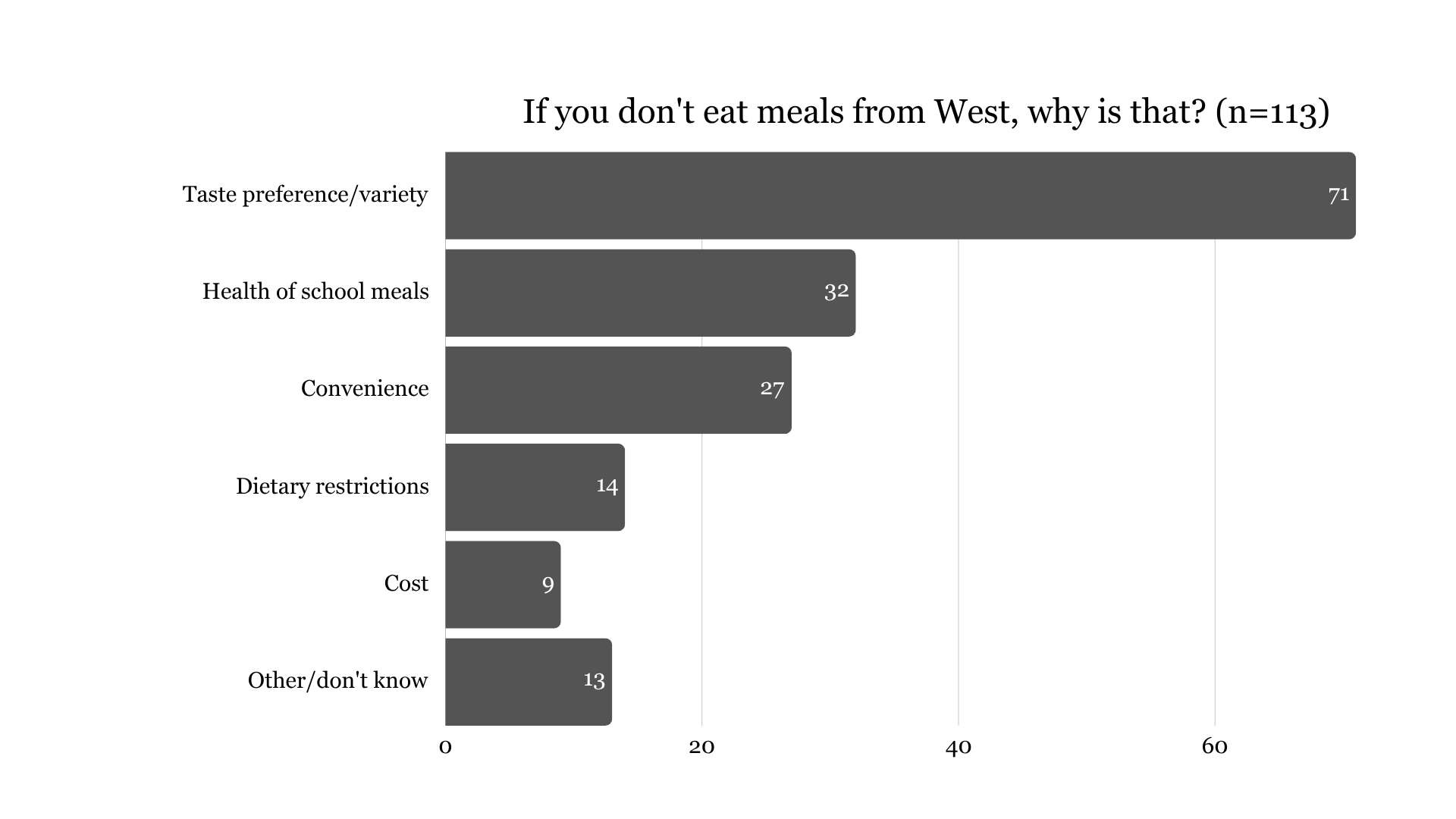
Investment in improving the quality of school meals would be welcomed by many students at West. Among the 178 respondents to a student body survey conducted this April, 39.9% reported taste preference or a lack of variety as a reason they choose not to eat meals at school. While critiques were wide-ranging, several students mentioned wanting the return of favorites from previous years, namely fries, pizza, and wrap dressings and toppings, while others complained that meat in entrees has an “off” taste or dry texture.
Taylor, a food service employee at West who declined to give his last name, has seen improvements in the school’s menu throughout the year.
“I would say the options are a lot better,” he said. “It’s not the same thing every Monday anymore like it used to be, and actually it’s easier to put together now because it’s more fresh foods than it is packaged.”
Junior Stella Schwersenska is glad to have greater variety at some new lunch stations.
“Six months ago, we had the same things literally every week, but I think we have more options now. At least that one station is constantly rotating, which is nice,” she said.
Although contracting with Chartwells has led to some changes in school meals, Miranda Prisland, Resident District Manager of Food Service in the OASD, says that this year’s menus are still limited by decisions made when the district had in-house food service.
“Commodities are planned in February for the following school year, so, when Chartwells came in, we kind of inherited a lot of commodity food,” she said. “You would recognize a lot of it on your menu. You probably see a lot of chicken patties, a lot of pork, taco meat, chicken nuggets. Those were all pre-selected.”
In February, a small panel of students from West’s Student Leadership Team sampled new menu items that Chartwells may bring to the school in the future. Senior Gabriel Balcom was among those on the panel.
“We had some pho, with the noodles. It was pretty good. We had buffalo chicken mac and cheese, we had Korean barbecue tacos, and jerk chicken with curry rice,” he said. “It was all really good, and more of the stuff was fresher.”
As West’s food service continues to evolve, students may have more opportunities to weigh in with their taste preferences. Prisland described one strategy Chartwells uses to let students guide their menus.
“Students sample different concepts, and they use their phone to scan a QR code, and they vote for their favorite,” she said. “They see the results up on a screen in real time, and the winner gets featured on their school lunch menu.”
Hearing student feedback on meals can be a two-way street, helping food service connect with students who tend not to eat school meals and showing them the quality of the options offered, according to Prisland.
“We also love to do Discovery kitchens, which is just a pop-up one-time, ‘Hey, we have this new menu item, why don’t you try it?’” she said. “Maybe they didn’t realize that we serve homemade tzatziki sauce, so why don’t you try it, and hopefully we can increase our participation that way.”
Prisland hopes that introducing new dining concepts can also make West’s cafeteria more efficient and navigable.
“High schools are challenging because of space and time, so I’m thinking about our point of service. We’ve branched out for breakfast. We’ve got breakfast in the hallway, second chance breakfast located all over,” she said. “For lunch, we have the O-Room and we have the F-Room, so are there opportunities for us to spread lunch out? Are there ways that we can have grab-and-go sandwiches for students who would normally kind of head out the door?”
Results from the April survey suggest that congestion in lunch rooms is a frustration for many students, and may weigh on school meal participation. Inconvenience or a long lunch line was cited by 15.2% of respondents as a reason they choose not to eat meals from West, and 11 students raised the time it takes to get lunch in an open-ended response about areas for improvement in the school’s food service. Walking to lunch from classrooms across the school, Schwersenska has dealt with this disorder.
“I had friends that would save spots because I wasn’t there for at least half of lunch, if not more,” she said.
Contracting with Chartwells may bring not only new flavors and a more navigable lunchroom, but more homemade food as well, especially at the district’s middle and elementary schools. Because these schools lack the kitchen equipment necessary for scratch cooking, all of their food is currently prepared at West or, to a lesser degree, Oshkosh North in the morning and shipped out in time for meals. However, Niehans notes that a priority for the OASD’s food service is localizing cooking at elementary and middle schools, aided by the reconstruction of buildings across the district.
“All of our new buildings that we’ve had built in the last couple years and the ones that are currently getting built, those kitchens are being designed to make from scratch,” he said.
While scratch cooking has been making its way into the OASD’s elementary and middle schools this year, Prisland observes that, between infrastructural limits and health department regulation, there is still a way to go turning the fresh philosophy into practice.
“For instance, Menominee Elementary, they are not cooking their own food. They are definitely able to. They have reach-in coolers and freezers, and really for them to have their own production kitchen they need maybe a walk-in, so they’re limited in that way, but there’s definitely ways to do it,” she said. “We could still send cases of our product to Menomonie on a daily basis uncooked, and they can cook it there. That is the plan, to have cooks at every location preparing the meal there.”
Preparing more food for elementary and middle schools on-site will also free up equipment, space, and prep time at West to allow for more varied and fresher cooking for the high school. Prisland identifies a number of benefits to cooking from scratch.
“You know what’s in your food, you know where it came from. It’s less processed, less additives, with better nutritional availability. From a food allergy standpoint too, I know exactly what’s in there. There’s no risk of other ingredients being added,” she said. “It’s usually better received by students versus something that’s set in a freezer for months and months before it’s gotten to them.”
Many students feel that school meals are lacking in nutritional value, with 18.0% of survey respondents saying that they choose not to eat school meals because it is not as healthy as their own food. Sophomore Elijah Fredette would like to see options higher in protein and fiber, especially at lunch.
“I know sometimes the foods lack nutritional value. There’s the fruits and the vegetables, which is good, but I noticed that a lot of the main things are greasy and unappetizing,” she said. “For people that are on a calorie deficit, the Doritos are really high in calories, and that’s something that people probably won’t eat.”
Schwersenska, who has had to track calories for sports, says that it can be difficult for students with dietary restrictions to navigate school meals because of the lack of nutritional information available.
“At school, we aren’t really provided with any nutritional information, so I was kind of limited to just eating the subs every day because it was fairly simple to find out the calories of the average bun, deli meat, or whatever,” she said. “I think the nutritional information that comes with the food needs to be somewhere that’s accessible because I would like to be able to know what I’m eating. It could be on the stations or online, just somewhere we can find it easily.”
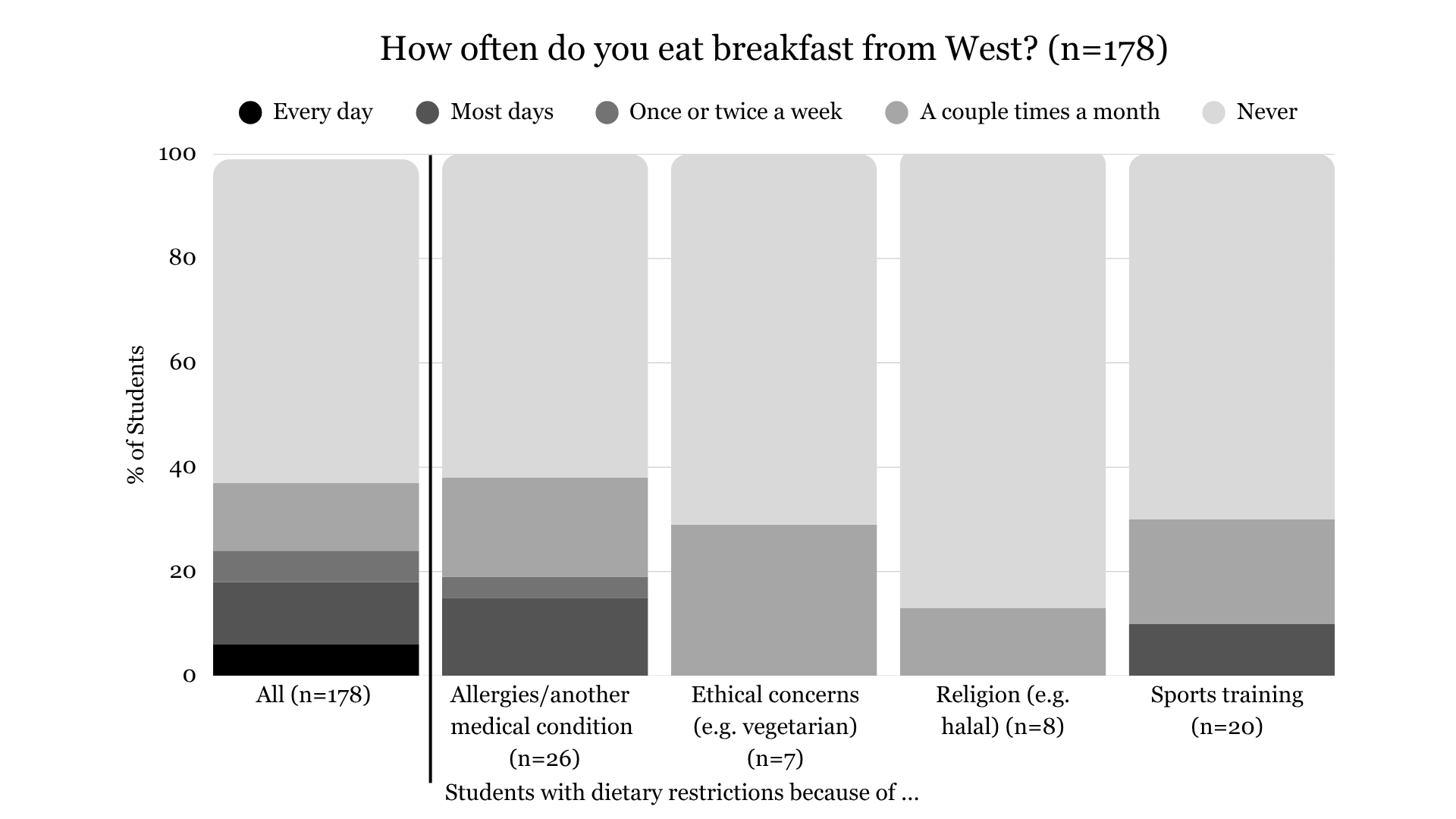
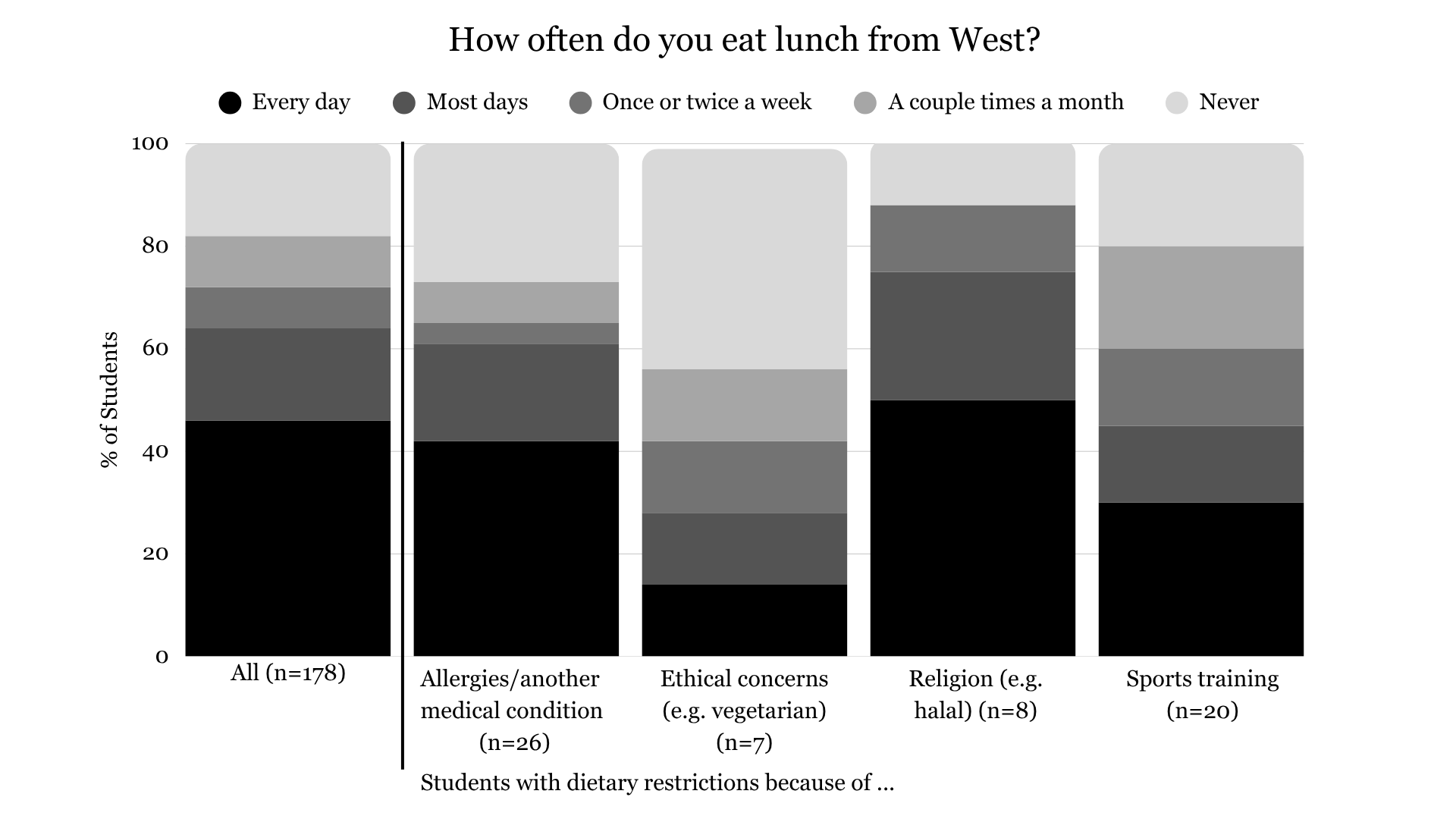
Better labelling may also make it easier for students with medical conditions to navigate the lunch room. In the April survey, 14.1% of respondents reported having a dietary restriction due to an allergy, food intolerance, or other medical condition. These students participate in the school meal program at a significantly lower rate, with 26.9% of students with allergies or other sensitivities saying they never eat lunch from West, compared to 16.4% who do not have such dietary restrictions.
Even when they have safe choices, students with allergies and sensitivities might find their school meal options are of lower quality than those available for all students.
“Have options for people with and without restrictions, because some stuff that is gluten-free doesn’t taste as good as stuff that has gluten,” suggested one anonymous student.
Children’s highest-quality meals tend to come from schools. A 2018 study found that only 24% of school meals were of low nutritional quality, compared to 80% of children’s meals at restaurants and 45% at grocery stores. Prisland points to various federal regulations that contribute to their nutritional value.
“Back in 2010 is when they passed the Healthy, Hunger-Free Kids Act, and that really made a big change in the USDA meal program and a lot of the a la carte items. So anytime we sell something a la carte, we have to run it through a Smart Snack calculator to make sure it meets those regulations,” she said. “Added sugar has been regulated in their a la carte items, so you'll notice that we don’t serve regular soda. We serve reduced fat versions of Doritos. Our ice cream is reduced fat ice cream.”
More important than focusing on specific nutrients is eating meals with nutritional balance, according to Prisland. She says the structure of reimbursable school meals pushes students to incorporate healthy portions of all food groups.
“At lunch they take three different food groups, and at least one of them has to be a half cup of fruit or vegetable, and then usually the entree item is two other components,” she said. “If you think of a slice of pizza, that crust counts as the grain and then the cheese or the pepperoni counts as the protein.”
Beyond the taste or health of food, students often expressed wanting to have more generous servings at meals. In the April survey, 10 students mentioned wanting larger portions or the option for seconds in the open-ended response about changes they would like to see in the school’s meals, especially since students were allowed to get free second portions in previous years. Niehans explains that the return to tracking meals with student lunch pins and restricting students to one free meal was a legal necessity.
“We got audited this year to make sure we are compliant, so had we not made that change and DPI came to West and saw that we were not even trying to track that there is more than one meal going to a student; they would actually fine us and make us pay all that money back,” he said.
Although she understands why the district had to re-enact a limit on the servings students take, Fredette believes that limits on the food students take could be antithetical to helping them develop healthy habits.
“With breakfast and the limit on the grains you can take, I’m not mad about it, but it just confuses me because breakfast is a big part of the day and helps your body get going,” she said. “For people who work out, they need those calories and those benefits from food, so they would have gone back for seconds. It’s kind of hard to adjust to the change.”
Although many students commented about wanting larger portions at lunch, those who follow diets for personal reasons reflected that it can be difficult for them to find school meals they can eat at all.
“There have been days when there was nothing I could eat because I’m vegetarian and I have had to skip lunch,” wrote one student.
Prisland says that, in the future, the district’s food service will aim to incorporate plant-based sources of protein, such as beans and lentils, into meals, not only to cater to students with dietary restrictions, but to encourage a more diverse, balanced diet across the student body.
“It’s about expanding what they know as food and what’s available to them, and incorporating different types of fruits and vegetables and different forms of protein,” she said.
In addition to helping students find nutrient-rich foods, this expansion involves offering a more varied flavor palette to appeal to all students’ tastes, according to Prisland.
“We’ll run the Global Eats program, which features a different cuisine every month,” she said. “So one month we might feature Italy, one month we might feature the Mediterranean, or we might feature Korea, recipes incorporated into the menu on the Create Station from different countries.”
Balcom appreciates that the dishes offered at the taste-test in February drew on various global cuisines.
“I liked seeing the options they had. They were more diverse options,” he said. “I mean, we have the burrito bowls, we have the Asian bowls, but just seeing more of those different things so it’s not pizza every day.”
Beyond the lunch lines and menus that students engage with each day, the switch to private food service management has presented some challenges. Taylor and Ally Kilday, another food service employee at West, reflected together on the limited communication with staff throughout the transition.
“They showed up one day. There was no warning,” they said jointly. “They introduced themselves and said they were going to be taking this over. They were supposed to be just a contract, and then we found out they’re staying, but everyone has been super nice so far.”
Niehans believes that working with Chartwells will ultimately provide new opportunities for the employees in the district’s kitchens.
“I have found in my prior district when we transitioned the same process, it really is not only best for the district to fully remove and get food service out-of-house, but also typically the staff members end up with pay raises,” he said. “If what they want to do is really make a lasting career within food service, there’s many more opportunities with Chartwells. They belong to the largest food service company in the world. They’ve got lots of paths for people to go in different directions within their organizations.”
The district’s food service workers will begin their new contract with Chartwells this July. While they have been guaranteed they will not see a pay reduction, Kilday says food service employees have not heard anything about getting a raise with the switch to private contracting. Taylor also observes that the switch will lead to the loss of key benefits of working for the school district.
“I need the insurance for me,” he said. “When they take over, we lose the district insurance, which is phenomenal, and the retirement plan and everything.”
Per DPI mandate, the district’s emergency contract with Chartwells followed a fixed cost model, so the district has borne the brunt of food service costs if there is low student participation in its meal programs. Meanwhile, the OASD has had to continue paying the majority of its food service staff’s salaries because these workers are not yet contracted with Chartwells. As a result, the district has had to dip into a reserve fund to support its food service, although Niehans is confident that this will be made up for in the future.
“We will be shifting to a cost reimbursable contract and out of a fixed cost,” he said. “Next year, we have a guarantee that we are going to profit, and it’s written right into the contract, ‘No matter what you are going to make this money, we [Chartwells] will eat the rest if we don't perform that.’ And that forces them to make sure that they have an interest in driving participation.”
Although Chartwells has plans to continue its service in the OASD, Niehans says that, as of the time of this reporting, the district’s food service contract for the coming years had yet to be fully approved.
“DPI did approve the recommendation,” he said. “The school board will vote on the resolution to approve Chartwells for the contract at the next school board meeting on April 22.”
by Aria Boehler
Published April 27, 2026
Oshkosh West Index Volume 122 Issue VII