Caddies provide universality in technological rule enforcement
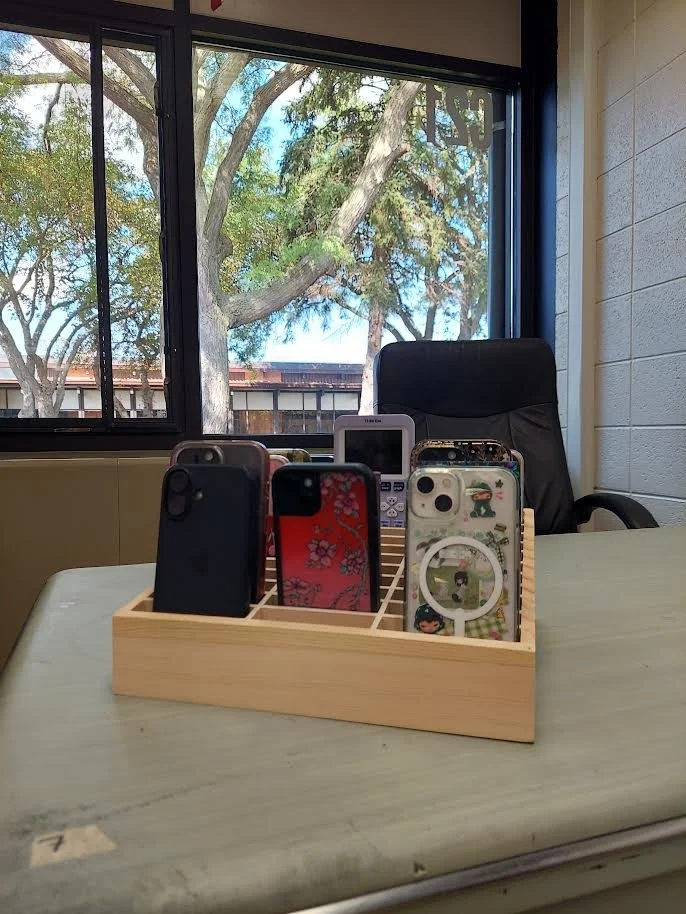
West has adopted a new addition to universally implement the electronic policy, focusing mainly on the usage of cell phones during class time. At the beginning of class, students now turn in their phones to a caddy and are allowed to retrieve them only with teachers’ permission. The new Wisconsin state law, prohibiting “wireless communication devices” from schools during instructional time, is a contributing factor to this change. However, staff believe that the extra measure to keep devices away has noticeably improved engagement.
Principal Rebecca Montour considers phone caddies to be extremely helpful for teachers, creating less need for constant enforcement for phones being put away.
“There's the new state law, that students can't have their cell phones during class time, which has kind of been our rule anyway, it needs to be put away. But, it’s really hard to manage in the classroom for the teachers,” she said.
Montour explained that the changes to the policy weren’t completely new and had been tested before on a smaller scale.
“Some of our teachers started experimenting with having kids turn in their phones last year. I think the Global Academy did, social studies did and math did, and felt it was pretty successful,” she said. “We decided it’d just be easier to have a consistent rule, school wide, making it easier for the staff, easier for the students to know the expectations.”
Although the state law did increase the need to implement phone caddies, Montour explained that it wasn’t the only reasoning behind the change.
“I think we would have ended up here anyway, just because we know it’s better for kids to help them stay engaged without that distraction,” she said. “Because even as adults, like when we have our phones on us and can feel vibrations, we get distracted too. The idea is it just takes the burden off.”
In addition to having students turn in their phones, teachers must ensure that the rule is being followed. Assistant Principal Justin Hable defined phone caddies as another layer to a pre-existing policy, with similar discipline to offenses.
“First offense would be: held by the teacher for the rest of the class period. Second offense, you turn it into the office for the day and then it just progresses from there. It’s the same policy we've had. It’s just now there's an extra layer,” he said.
Math teacher Jason Lasee noted that though students may complain that the policy is inconvenient, there haven’t been a significant number of rule-breakers.
“As a hall supervisor, I had more of an issue with somebody who told their teacher that [their phone] was in their backpack, and then I saw it in the hallway, and I walked them back,” he said. “They now have to be written up, because they didn’t turn it in.”
Adding phone caddies to every classroom took additional funds. Hable explained that the previous assistant principal, Gillian Pakula, had earned the funding through a grant.
“She was working with a partnership of people, a company that’s looking to promote good mental health in students and looking for ways that they can support schools,” he said. “And so she applied for this grant for the organizers just talking about student engagement. You know, when students are on their phones, we’re finding a lot of issues and things going on. She was awarded the grant.”
Hable believes that cellphones cause inevitable distraction when they are in immediate access for students.
“Even when the watch buzzes, we want to look at it. It's like that temptation of knowing it's there and thinking about it, just kind of reduced engagement in classes,” he said. “Before I moved up to A.P. I knew some of this was happening, what the school wanted to focus on is— how can we increase engagement? Because when you're in school, that’s what we’re here for, to learn.”
Not only are students more engaged in their classes, but they also seem to be interacting more with their peers. Lasee noticed more conversations.
“I am seeing when we have a W-hour or something like that, a lot of students are actually talking to each other. And doing stuff and it’s not always academic which is okay,” he said. “But, they're communicating in other ways. I think that’s a great step in the right direction, even if it's not 100% academic, still a step away from our devices.”
Staff has been appreciative of the new policy, because it has decreased their workload. Before, they would need to monitor for phones while teaching as well. Montour shared how they felt.
“They have said that it has relieved a lot of stress for them, of feeling like they have to police the room, looking for cell phones all the time,” she said. “They said they have noticed the students are just more engaged. The kids are much more willing to participate.”
Lasee agreed that this “policing” was a much greater stress before this change, and now teachers’ jobs will be a little simpler.
“There isn’t a need to check everybody’s pocket. I mean, not that we were doing that, but we know there’s some burner phones out there or friends’ phones,” he said. “We know it’s gonna happen, but it again takes away the whole warning situation. If I don't see it, it’s not really a problem anyway, is it?”
Some students may feel that the caddies are overreaching and lead to more problems than solutions. However, Lasee stressed that having them is actually more convenient.
“We do have some students with medical needs, we’re aware of that. And we don’t harp on them about that because they need it,” he said. “It’s a necessity for some people. But I’ve only had a couple really say much about, like, I want to keep it in my backpack.”
The phone caddies may be here to stay, but Lasee assured that further changes are always open for consideration.
“We’ll always tweak it a little bit, but I don't see it going away. We already have the no AI glasses, because those are problems for privacy,” he said. “So those need to be gone, and they are from what I can tell. As technology changes, we have to change with the times.”
by Samreen Chahal
Published October 5, 2026
Oshkosh West Index Volume 123 Issue 1