Walkout attempts to break ice on discourse over immigration policy enforcement
The usually quiet streets around West were filled with a cacophony of student chants, car horns, and revving engines on the morning of Feb. 5. In lieu of attending their second hour classes, nearly 200 students marched around the school and surrounding neighborhood in a demonstration against aggressive immigration policy enforcement seen throughout the past year. Many students carried signs made at home or at gatherings after school, bearing slogans like “Abolish ICE” and “Liberty is a right, not a privilege” in English and Spanish, while chants called for the welcoming of immigrants and the scaling back of ICE operations.
The march gained the attention of the surrounding community, with several cars along Sawyer Ave. and Witzel St. honking in support and some district parents parking along the route to cheer on demonstrators.
Planning for the demonstration began after several students discussed a walkout held at Menasha High School on Jan. 20 to coincide with a national protest on the anniversary of President Trump’s return to office. Spanish teacher Rick Webster put this on the radar for some students, who then organized the walkout.
“Everybody already knew that Menasha had walked out, so it’s not like I was telling them anything that they didn’t already know, but I think it just maybe gave them the idea that they can do that here as well,” he said. “Some people decided that they were interested in being a part of it. Some people decided that they weren’t interested for various different reasons.”
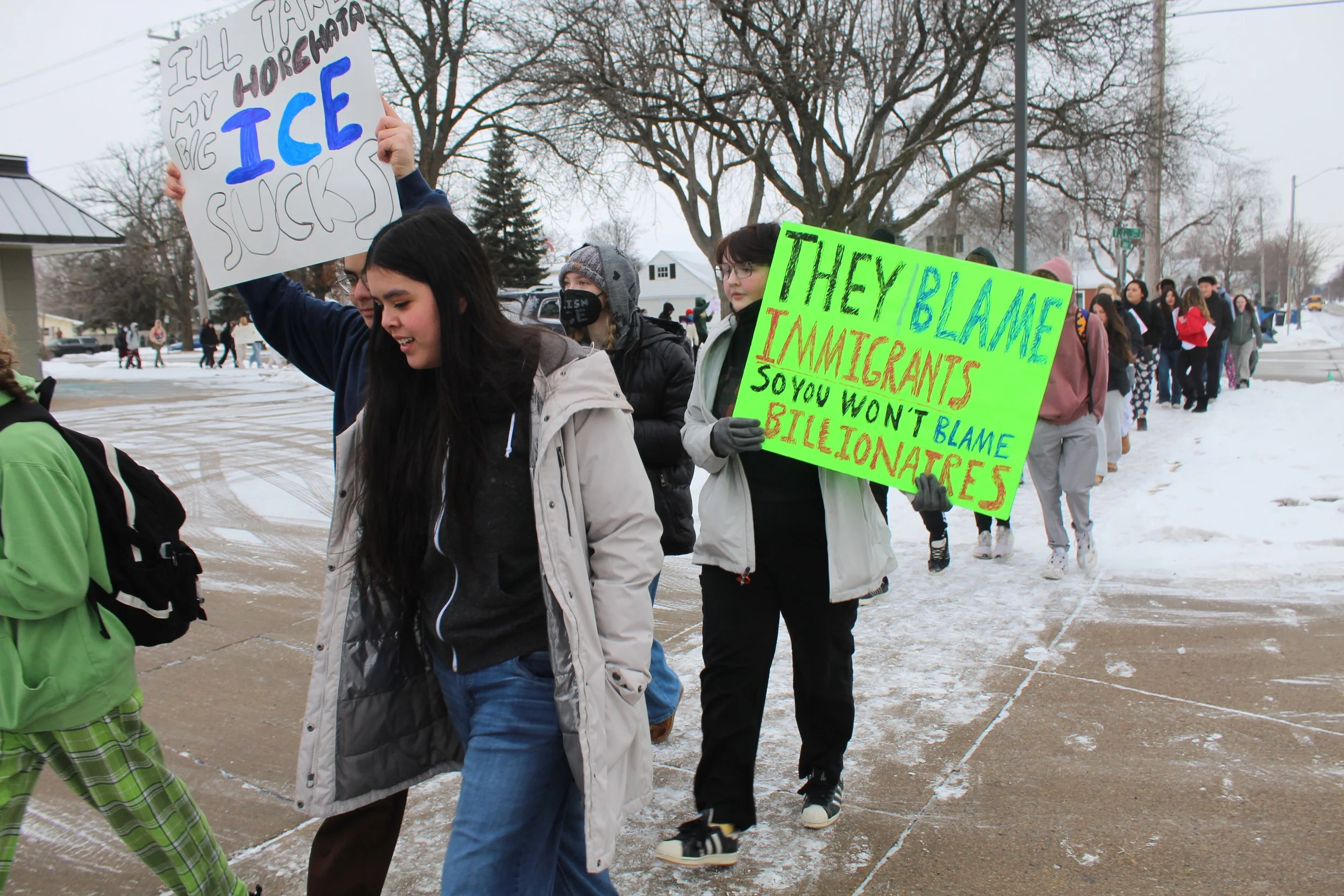
Students quickly began organizing the walkout, which was not endorsed by West administration. Junior Astrid Larson, a member of West’s Youth2Youth Advocates for Justice (Y2Y), said that the club was responsible for much of the early planning.
“During that last meeting, we mostly talked about what exactly we were going to do and especially how we were going to advertise it,” she said.
After Y2Y set a day and time for the protest, students began to spread the word. Recognizing that too much publicity could cause antagonism between students or encourage a potentially confrontational pro-ICE counter-demonstration, organizers communicated primarily within clubs and trusted friend and peer groups. After learning about the walkout through the West Leadership Team, senior Maggee Hild shared information about it with friends who she thought would be interested in attending.
“We didn’t want it to be crazy around the fact that we didn’t want someone doing pro-ICE protests as they kind of stated was going to happen, and the rumor of that spread around,” she said. “I kind of just spread the information and it got talked about a lot because people were posting it publicly online.”
School administrators learned of the protest coincidentally. Ahead of a nationwide general strike on Jan. 30, Principal Rebecca Montour met with student leaders whom she suspected may have been organizing a protest for that day. This meeting sparked conversation about the walkout that eventually took place on Feb. 5. It was important to Montour that administrators communicate with students about safety and attendance policy surrounding the demonstration.
“If students are going to be using their rights of free speech, they’re still our students, even if they’re off school grounds,” she said. “We wanted to be able to coordinate with local law enforcement and speak with parents so that everybody understood what the parameters were around it.”
According to Montour, two Oshkosh police officers monitored the students’ route during the walkout, and additional officers were on standby. As rumors of a counter-protest grew, so did concern about the potential for misconduct or hostility, and Montour worked to head off these issues before they arose.
“I spoke to a student who would have been organizing that to see if there would be two protests at the same time, can we talk about different routes that we’re taking, or do we want the leaders of each protest to get together in advance and have a dialogue so we can create some ground rules,” she said. “When I met with that student, he told me that they had talked about it and decided not to do anything.”
Larson noticed a few students who did ultimately turn out in support of ICE.
“There were a couple people riding around in cars flipping people off,” she said. “I was expecting a little bit more resistance.”
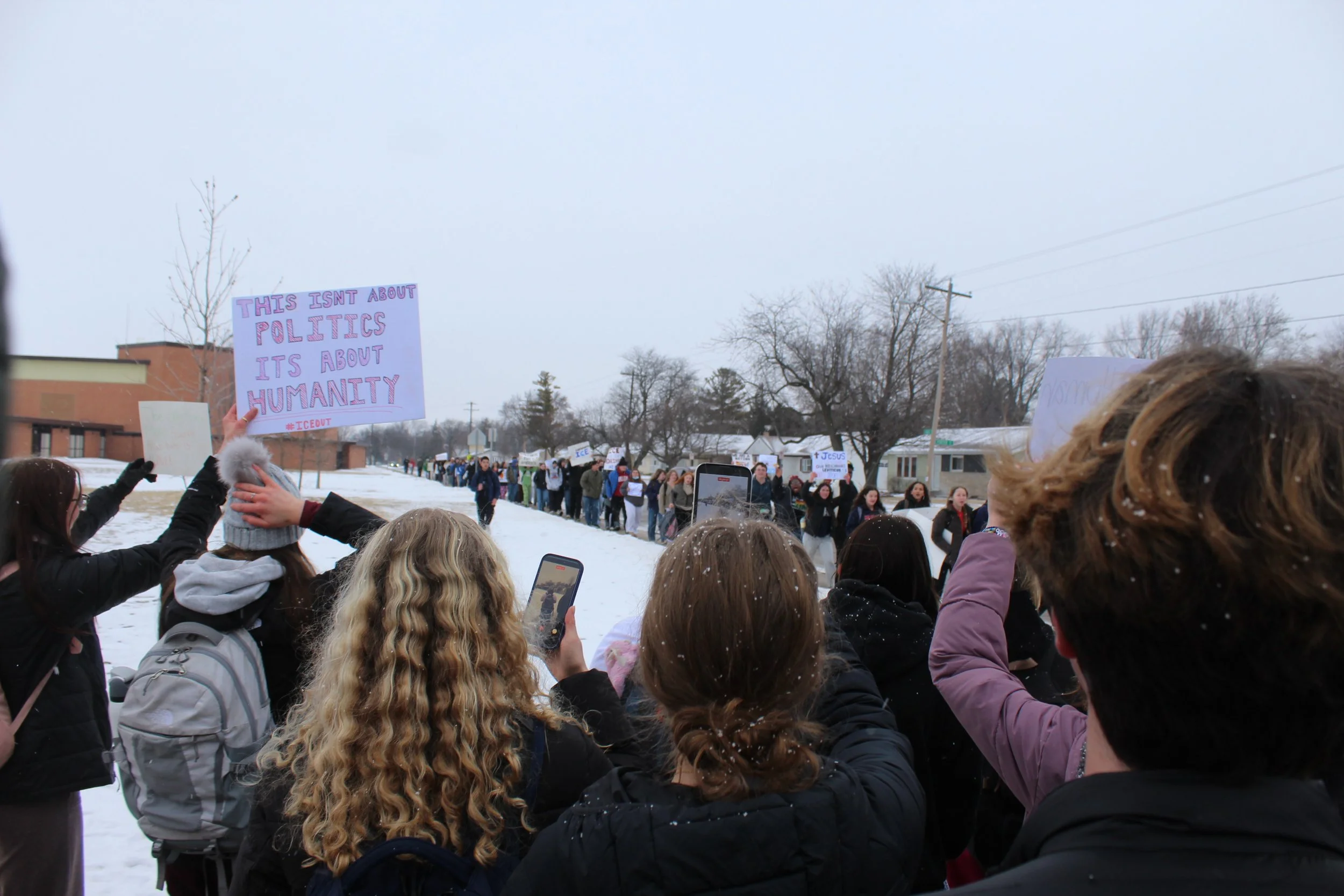
According to Montour, there were also a few student families that contacted the school to express displeasure over the walkout.
“I think more the complaint was they think politics should be out of school, and they thought the walkout was letting politics into school,” she said.
Maintaining distance between the student demonstration and the school, administrators focused on coordinating school policy around the walkout to minimize the effect on learning and student culture, according to Montour.
“We did lift a portion of the attendance policy, our closed campus policy, for this because we felt like it would be less disruptive to the school to just say, okay, everybody come back in and please go to your classes right away,” she said.
On the morning of the walkout, 86 students had RSVPed to attend. West’s attendance office reported 81 students were called in by a parent to participate, and 100 more are assumed to have participated in the walkout, having been marked unexcused absent for only 2nd Hour. Larson noted the line of demonstrators stretched along multiple blocks.
“I remember starting in the back, hearing people at the front chanting, and there were multiple chants going on at the same time,” she said. “The line was so long, you just couldn’t tell.”
Nationwide protests against ICE were galvanized early this year by Operation Metro Surge, ICE and Customs and Border Protection’s aggressive crackdown on undocumented immigrants in Minnesota. In particular, the detention of 5-year-old Liam Conejo Ramos, the seizure of a barely dressed US citizen from his home, and the killings of Renee Good and Alex Pretti, both US citizens, have sparked outcry. While the fear and outrage triggered by such events may have motivated many West students to walk out, the atmosphere of the protest was uplifting and communal, according to Larson.
“People were just smiling and getting really into it,” she said. “We were just happy that we felt like we were actually doing something, instead of being observers.”
An anonymous sophomore who attended both after-school sign-making sessions appreciated supporting peers and sharing her voice with signs calling for the scaling back of ICE operations.
“It resonates with me because no one, other than Native Americans, didn’t immigrate here,” she said. “My mom is an immigrant, and my dad came from immigrants from Europe, as most white people do, so I think there’s that concern.”
Like much of the American public regarding this polarizing issue, many other students support current immigration tactics. Junior Brekken Urban was among the students who turned up against the main demonstration, drawing “I 🖤 ICE” on his back windshield for the occasion.
“I can understand the aggressive tactics used by ICE agents because assaults against ICE agents have gone up significantly since the start of this administration’s second term, and they have the right and duty to protect themselves,” he said. “I have seen some videos of ICE agents doing things, such as killing Alex Pretti, that I do not support, but ICE is not the only agency where officers may use extreme tactics. People may think that ICE is a terrible, violent organization because every single little bad thing they do gets blasted on the news and demonized.”
Personal politics were not the only reason students chose not to participate in the walkout. Because students were marked absent if their parents or guardians did not excuse them for the demonstration, they had to navigate family members’ political views or concerns about skipping class.
“My parents are more conservative, and they’d be like, I’m gonna take you off the street if I see you out there, so I couldn’t really do that,” said the anonymous sophomore.
Before the walkout, multiple students with immigrant backgrounds or family ties approached student organizers to inquire about the likelihood of threats to their safety and privacy. While organizers provided a limited number of gators and demonstrators were encouraged to bring their own mask if they feared for their privacy, such concerns likely kept several students from participating.
The walkout at West did not come in isolation. A smaller group of students walked out of class at Oshkosh North on Feb. 16. Nationwide, thousands of students have taken part in anti-ICE demonstrations since the beginning of Trump’s second term, The Guardian reports, and more than 300 protests were organized on the National Shutdown on Jan. 30.
Political leaders have taken notice of the public’s discontent. Two days after Pretti was killed, Tom Homan, President Trump’s border czar, assumed leadership of the administration’s deportation campaign in Minnesota. On Feb. 12, Homan announced the scaling back of the operation after negotiations with state and local leaders.
Meanwhile, Senate Democrats staged a protest of their own by refusing to pass funding for the Department of Homeland Security, which ICE is a part of, without reforms like mandatory use of body cameras, the end of roving patrols, and a ban on agents wearing masks while operating. This triggered a shutdown of the department on Feb. 14, also restricting the operation of the Federal Emergency Management Agency, the Transportation Security Agency, the Coast Guard, and other services unrelated to immigration.
Larson hopes that students will continue advocating for reforms to current immigration enforcement and raise larger demonstrations or partner with other advocacy groups as possibilities for the future.
“I would say the goal of the walkout to me was just to show that people are against this, and to join the movement that has been coming together as a nation,” she said. “It was definitely a big step. I think there was a lot more we could do.”
by Aria Boehler
Published March 2, 2026
Oshkosh West Index Volume 122 Issue V