Baby Keem rolls dice with long awaited follow-up to ‘Melodic Blue’
Recently anointed by Spotify as one of hip-hop’s next messiahs, rapper, producer and singer Baby Keem (Hykeem Carter) has released his long awaited second studio album, Ca$ino. Though it feels like just yesterday, Keem’s last project, The Melodic Blue, came out in September 2021. In the intervening years, it is clear he has matured significantly, as Ca$ino stands as by far his most reflective and cerebral work.
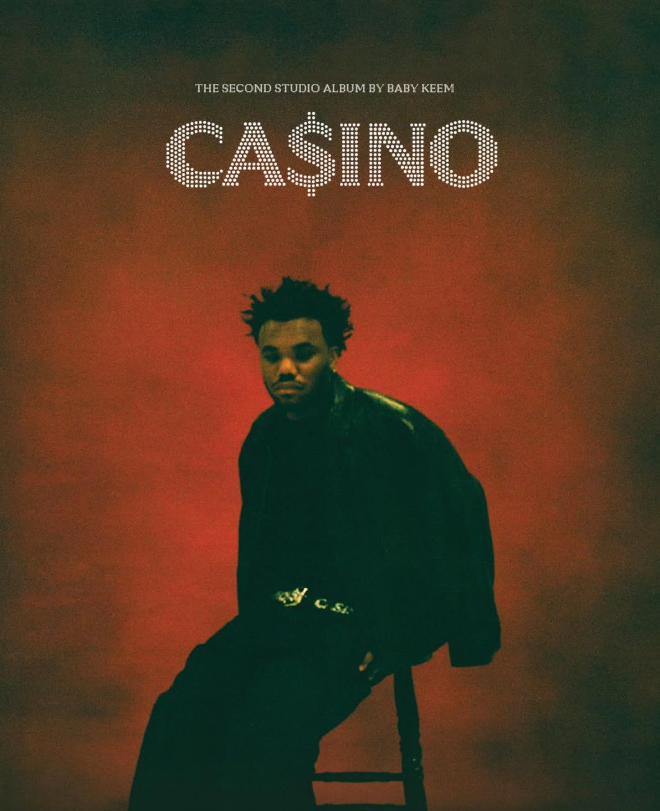
Baby Keem first came to prominence for his behind the scenes contributions to the Black Panther soundtrack in 2018, when he was only 17-years-old. He was hand selected by his cousin, rap superstar Kendrick Lamar, who saw potential in Keem’s production. He really made a name for himself as a solo artist, though, with his 2019 quadruple platinum single “ORANGE SODA,” where his high-pitched voice became a defining characteristic. The Melodic Blue was Keem’s assertion that he was more than just Lamar’s cousin, almost serving as his childhood rebellion phase, as he was only 20 at the time of its release. He really just threw ideas at the wall with the hope that something would stick, and luckily for him, it worked as Melodic was received extremely well critically.
While the wild experimentation and unpredictability of The Melodic Blue was charming at the time, Keem understood the high expectations he set for himself could only be met by something more refined. Unfortunately, while on the surface Ca$ino seems like the polished, inspired project the artist needed, with some of the highest highs hip-hop has seen in the past few years, a second look starts to reveal cracks.
As usual, Keem takes a front seat on the album’s production, implementing his trademark beat switches so often throughout that the 10-song runtime starts to feel more like 20. While a couple of creative transitions could have been interesting, the frequency with which they appear makes the tracklist feel disjointed. At several points, a song seems to be heading one direction, often an appealing one, when Keem randomly changes the flow, seemingly without a reason.
Nowhere is this more apparent than on the album’s second track, the titular “Ca$ino.” In the beginning, Keem seems to be experimenting with a more aggressive rage sound, but then it fades, not even in a clever way, for a more flaccid, smooth sound. An attempt to capture the magic of The Melodic Blue comes across more annoying than anything. That said, “Ca$ino” doesn’t fail, but the production feels far too rushed and messy for an album which took years to release.
One main point in the title track’s favor is that it introduces the album’s concept, and in some ways, lack thereof. The whole project is a reflection of influences which have shaped Baby Keem’s life, the places, the people, the young love and heartbreak. All facets get summed up by the analogy of the aptly named Ca$ino, take the good with the bad, or something like that. The message gets a little obscured by Keem’s several attempts at sexy R&B which detract from the album’s cohesivity. He has a little experience in the genre, with the raunchy “Pink Panties” off The Melodic Blue, but it’s just so much less entertaining coming from a deep voiced, fully grown Keem.
Tracks like “Birds and The Bees,” “$ex Appeal” and even “Good Flirts” are all decent musically, but nothing impressive for Keem. Kendrick Lamar’s feature verse on “Good Flirts” is laughable, with him sounding the freakiest he ever has. The silliness may have worked back on The Melodic Blue with “Family Ties,” but when Kendrick is literally almost 40 it just doesn’t hit the same to hear him sing about booty. The exception to Keem’s weak pop-R&B fiascos is “Dramatic Girl” with Che Ecru. By no means a singer, hopefully Keem doesn’t try to be going forward; regardless, as a one off, it’s pretty fun.
That leaves only a few songs holding the whole project together; luckily those songs are pretty excellent. “House Money” is a critique of generational wealth and Keem’s lack of it. He continues the casino analogy, making references to his mother’s gambling addiction. Although the messaging is powerful, it’s scarce, not overwhelming. Meanwhile, “Highway 95 pt.2” is a beautiful encapsulation of Keem’s childhood. He raps over a delicious bassline, “I wake up as a burden, I’m the kid that no one wanted.” Both Baby Keem’s mother and father were absent, leaving him to be raised by his grandmother in extreme poverty, making financing him an impossible challenge.
Ironically, Keem’s most lyrically talented display comes on “I am not a Lyricist,” which is arguably a perfect song. Keem tells his life story over some beautiful piano chord progressions, employing a voice like that of André 3000 of the legendary rap duo Outkast. If “I am not a Lyricist” is where Keem’s musical career is headed, the world has a lot to look out for.
Rounding out the project is No Blame, which can only be understood through the first song on the album, No Security. The two in conjunction help to show the growth that Keem has experienced. He recognizes that as a kid, there was nothing protecting him, no security, largely at the fault of his mother and father. But a more mature Keem on the final song knows that his parents had it just as bad as him, he would have done the same thing they did, no blame.
It’s certainly not perfect, a little muddled at times, but Baby Keem still shows just as much promise as he always has. Ca$ino displays both the highs and lows of his career while deconstructing what it means to be a runaway, misfit and outsider.
Grade: B-
Baby Keem delivers flashes of creativity and energy in Ca$ino, but the album feels uneven overall.
by Isaac Considine-Buelow
Published March 20, 2026
Oshkosh West Index Volume 122 Issue VI