J. Cole closes decade in style with ambitious reflection of things past
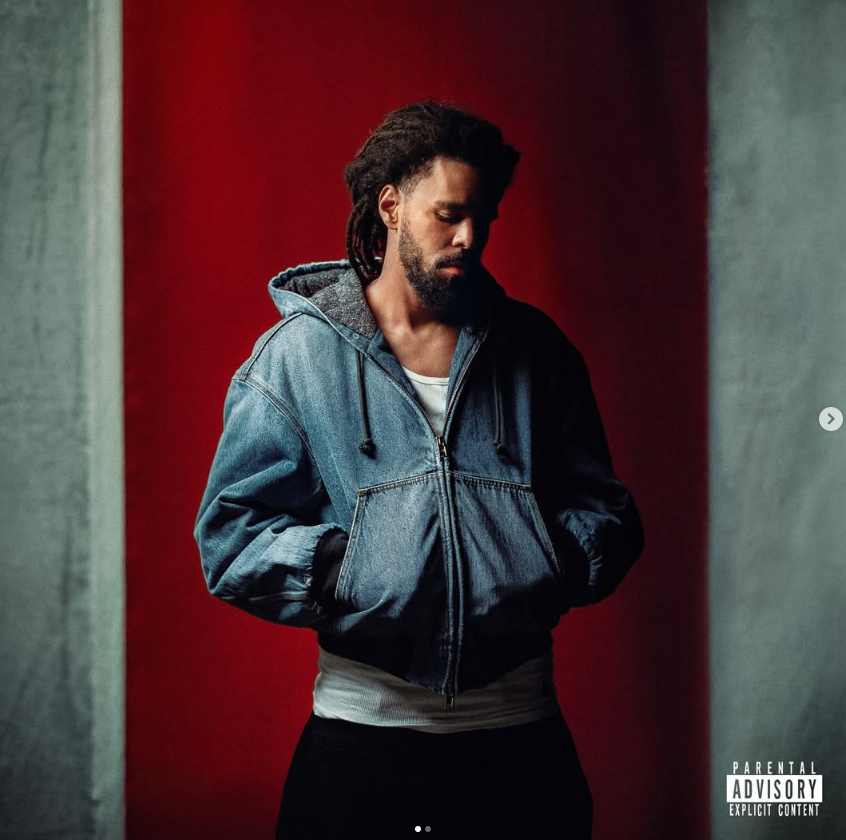
With double entendre hidden behind every door, rapper and producer J. Cole (Jermaine Cole) has released his final album, The Fall Off. Cole’s seventh full length project serves as the capstone for his sports themed discography which began with The Come Up on May 4, 2007. The rap giant’s tenured and decorated career now comes to a bittersweet conclusion with The Fall Off, a love letter to his life, childhood, and hip-hop. The record at number one on the Billboard 200 with 280,000 equivalent sales, the largest commercial release week for an artist in the genre in almost a year.
The widespread success can be attributed not only to Cole’s general popularity, but also a combination of well received songs leading up to the release. On Jan.14, 2026 he released a trailer for the album, along with a single titled “Disc 2 Track 2” teasing that the project would be a double album. The single, later revealed to be named “The Fall Off is Inevitable,” along with accompanying music video, is a beautiful piece of art where Cole raps his entire life in reverse, starting with his death. He weaponizes his notorious lyrical talent to break down everything that brought him to where he is today.
Drumming up just as much if not more buzz was the note from Cole that preluded the song, most importantly, the first and last lines, “For the past 10 years, this album has been hand crafted with one intention: a personal challenge to myself to create my best work… I owed it first and foremost to myself. And secondly, I owed it to hip hop.” High expectations from fans climbed even higher with this declaration to an almost unattainable standard.
And yet, Cole continued to impress. On Jan. 27, 2026, one day before his birthday, he released Birthday Blizzard ‘26, a set of four freestyles on his personal website which have yet to be released to streaming officially. He flowed with characteristic effortlessness over classic hip-hop beats, creating even more of an online ruckus.
The day the album finally dropped, hype for Cole was as high as it could be. Unfortunately for him, it somewhat backfired. The tower he built out of a project which is anything but flashy came crumbling down upon him. The album is by no means awful, but when it’s intended to top an already legendary discography, it can’t help but disappoint. It’s a nearly two-hour long exploration of J. Cole’s 40 years of life, designed to age gracefully and meaningfully rather than make a splash.
Broken up into “Disc 29” and “Disc 39, The Fall Off illustrates the artist’s growth over the course of 10 years. The former opens with the aptly named “29 Intro,” sampling James Taylor’s southern ballad “Carolina In My Mind.” Cole pays homage to the state which he grew up in, North Carolina, specifically Fayetteville. The city of Fayetteville has one of the highest poverty rates in the country which also has caused an increased crime rate, specifically within the large black population. Full of references and reverence for Fayetteville, Cole recognizes its part in his formation. Even the release date 2/6/26, is an allusion to Fayetteville’s shorthand “26”, being in Cumberland county, the 26th in the state. Meanwhile, as Taylor’s song crescendos, muttering in the background grows louder until a car and gunshots can be heard, a driveby. The rapid transition represents Cole’s innocent nostalgia being stripped away when he returned to Fayetteville at age 29, having made enough money from successful singles to “make it out of the hood.”
Continuing the trend, “Two Six” is a melodic, modern deconstruction of systemic violence in impoverished neighborhoods. Cole relives the caution he heeded growing up, making the song eerie enough to have one checking over their shoulder whilst enough of a hit to stay enthralled. The next song, “SAFETY” expands on this; Cole raps a voicemail to himself from the perspective of someone still living in the “Ville” over a boom bap beat. The influence of groups like A Tribe Called Quest are obvious in the instrumental backing, providing a somber yet optimistic tone as Cole reminisces about the old days from a friend’s perspective, managing to pack similar themes of incarceration and crime while also broaching internalized homophobia in urban communities.
One of the record’s few features, “Run a Train” has Cole and Future singing and rapping in a jazzy haze. The distant foggy feeling is thematic, as the song is all about getting away and coping. Cole’s first verse includes a line emblematic of the entire album, especially the first disc: “Fayettnam, you my heart but at the same time, if I’m being honest I can feel that flame dyin’.” The unending death and violence becomes too much for Cole, and his capacity to appreciate his hometown is being diminished and with it his ability to love as a whole.
Future returns on the mellow “Bunce Road Blues” with Nigerian singer Tems. The quartet is rounded out by producer The Alchemist, an acclaimed hip-hop beatmaker who provides an ample field for the lyricists to play on. The song follows Cole’s train of thought as he drives down the titular Bunce Road in Fayetteville. He melodramatically considers the streets he grew up on, recalling the ways he stayed out of trouble by rapping.
Concluding “Disc 29” is the bonus track “Lonely at the Top,” which exemplifies everything Cole has experienced so far. He is so grateful for everything he has, the places he came from, and yet, he still has nobody to share his success with. Everybody either wants to be him, take advantage of him or dethrone him. He didn’t want the money to change him or everyone else, but he knows that it is inevitable. He hates himself for being so naive, but he also wants to rekindle the childhood innocence he once had.
True growth starts to show as “Disc 39” begins. “39 Intro” is surprisingly intricate for an intro track. With multiple beat switches and instrumentals throughout its six minute runtime, Cole comes across as more mature, his slightly deeper, calmer voice seems to be leading the beat rather than vice versa. His cadence demands respect and he’s not afraid to say it. He makes several references to the 2024 rap beef which he was initially a part of before he very publicly withdrew. He continues to defend that he made the correct and adult choice, fitting with the coming of age theme.
Marriage becomes a central topic on “Life Sentence.” A full-grown Cole reflects on how his relationships have changed as he’s aged. He is ready for forever and he recognizes that deep down, he always wanted a committed, monogamous partner. The melodic, feminine, R&B refrain in the harmony leaves a sweet feeling with the listener as the album continues to slow down.
“I Love Her Again” is a masterclass in rhythmic storytelling that follows the artist all over the country in his quest to chase a woman as they fall in and out of love in a story befitting a romcom. It’s a standout on the record, and the kind of song that one always wishes they could listen to for the first time again.
The public aftermath of J.Cole’s The Fall Off is a tale of disparate opinions. Some are screaming “give him a Grammy already” from their porches and the top of comment sections, while others think it’s good, but not comparable to Cole’s other projects. For as long as it took to create, it will probably take twice as long to fully dissect Cole’s magnum opus.
Grade: A-
J. Cole’s new album The Fall Off feels like a masterclass, it’s razor-sharp, and smooth enough to make wisdom sound like a hook.
by Isaac Considine-Buelow
Published March 2, 2026
Oshkosh West Index Volume 122 Issue V