‘Marty’ sends anxiety, blood pressure skyrocketing for audience members
Despite many claiming that ping pong is as much to the plot of Marty Supreme as finance is to The Wolf of Wall Street, Timothee Chalamet’s newest film remains one of the most talked about productions of the year, receiving 12 major nominations, including nine Academy Award nods.
The star-studded cast, featuring Gwyneth Paltrow, Odessa A’zion, and singer Tyler, the Creator, follows professional ping pong player Marty Mauser, played by Timothee Chalamet, attempting to simultaneously become world champion while making the sport big in the US. The film is loosely based on the life of former table tennis champion Marty Reisman, who was active during the 1940s and ‘50s.
Mauser immediately comes across as an arrogant hustler, working part-time at a local shoe store in New York City, allowing him to save up just enough to fly to London to play in the British Open.
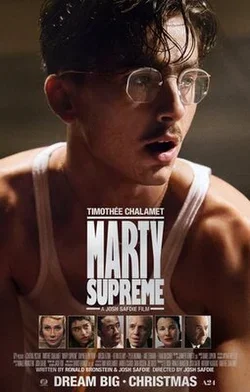
photo from Wikipedia’s Marty Supreme page
Although the ping ponger’s big dreams and aspirations seem to give the perfect opportunity to frame the Hero’s Journey for an underdog, Mauser quickly finds himself glued down in several sticky situations. In the opening scene of the film, Mauser races into the backrooms of the shoe store with married childhood friend Rachel (Odessa A’zion, Hellraiser) in what seems to be basic assistance, but quickly escalates into her becoming pregnant, which leads to the opening credits.
During Rachel’s pregnancy, Mauser seemingly falls into conflict after conflict with no end in sight over the span of the almost two and a half hour film. Despite overwhelming success as a ping pong player, Mauser picks endless fights with tournament managers, family members, and even the husband of the woman he hooks up with, actress Kay Stone (Gwyneth Paltrow, Proof). The seemingly ceaseless conflict leads the film to serve as a 150 minute stress fest for the viewer.
The several side plots lead to a variety of characters being introduced. Notably, former table tennis champion Béla Kletzy (Géza Röhrig, To Dust), whose backstory is briefly featured after Mauser beats him in a match. Kletzy is a supposed Auschwitz survivor, and while being stranded out in the forest of the concentration camp attempting to diffuse a bomb, he comes across a beehive and generously lathers himself in honey for his bunkmates to lick off. While a little bit out-of-pocket, the scene effectively juxtaposes Mauser’s greedy, selfish nature to the kindness and empathetic character of Kletzy. The “Honey Scene” received vast amounts of criticism for its unhinged nature, but primary issues come from the plausibility of the situation happening. According to Marty Reisman’s autobiography, competitor Alojzy Ehrlich was a survivor of both Auschwitz and Dachau, and the tales are accurate. However, Marty Reisman’s arrogant and somewhat hyperbolic nature proves him to potentially be an unreliable narrator telling tall tales. It’s unlikely that prisoners in Nazi concentration camps would desert other prisoners in parts of the camp with bombs to defuse, but the lore does offer extra nuance to Marty’s character.
After defeating Kletzy, Mauser moves on to the championship where he faces the deaf prodigy Endo (Koto Kawaguchi) from Japan. Endo’s character is loosely based on former player Hiroji Satoh and is played by real-life athlete Koto Kawaguchi. Chalamet reported learning the art of ping pong seven years prior to filming Marty Supreme in order to accurately replicate tournaments during the ‘40s and ‘50s. In the film, Mauser falls short of beating Endo in the championship game, which leads to him to be increasingly desperate to seek revenge.
Leading up to his next meeting with Endo, Mauser finds himself jumping from calamity to catastrophe attempting to raise enough funds to travel to the World Championship in Tokyo, Japan. Mauser picks up a gig as a part of the Harlem Globetrotters and takes part in a few mini ping pong matches for bets at a local bar. After acting like an incompetent competitor, sorely losing all of his matches, most men in the bar feel confident waging money on him losing yet again. Although things seemingly start looking up for Mauser, he quickly blows the money leaving him further indebted.
In an attempt to earn some extra money, childhood friend and almost due Rachel joins Mauser on a quest to return a lost dog. The ill-tempered owner denies any attempt at “stealing” the dog by shooting at the both of them. After a failed quest and still majorly indebted, Mauser requires some way to get him out of the hole. His outstanding hotel and restaurant bills eventually push him to go to pen monopolist Milton Rockwell (Kevin O’Leary, Shark Tank), husband of his side piece Kay Stone, and agree to lose a match to his rival Endo, in exchange for a flight to the World Championship in Tokyo.
WARNING: SPOILERS AHEAD!
After arriving in Tokyo, Mauser promptly loses his match, which pleases the Japanese audience. Mauser is pushed to kiss a pig as his consequence, but stops challenging Endo again. By the skin of his teeth, Mauser takes the win, disappointing the entire audience, aside from the US military members. Milton Rockwell is notably furious with Mauser, leaving him to fend for himself in Tokyo. Although this happy ending is in theory a phenomenal finale to the movie, it leaves Mauser still indebted and with no sponsors. He scrapes together just enough money to fly back home and is startled by the birth of his son. The film swiftly dances into the credits, leaving no implications on how Mauser will act as a father figure. This new reality that faces Mauser leaves ample room for interpretation for how he may develop or stay a static character who doesn’t learn from his boundless mistakes. The quick cuts and cinematography feature a unique story that ends relatively anticlimactically. Ultimately, the film uniquely captures a failed hero’s journey with no clear end in sight, allowing it to easily feature a potential sequel, especially following its box office success.
Grade: A-
Marty Supreme is the kind of movie that makes critics forget their cynicism and audiences leave the theater grinning like they just witnessed something special.
by Zosia Bowlus-Jasinski
Published February 9, 2026
Oshkosh West Index Volume 122 Issue IV